.x-iso-container-posts>.hentry .entry-wrap { background-color: #000000; } -->

Saturday, April 17, 2021

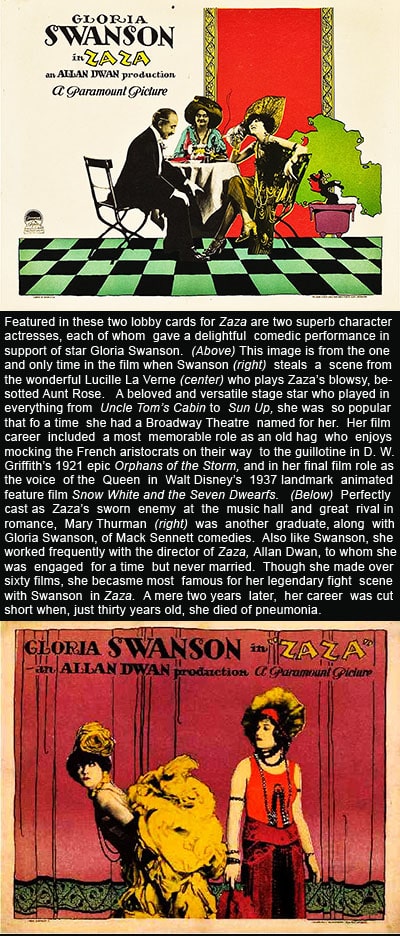
ZAZA - 1923 - Gloria Swanson

 ZAZA  (1923)

Gloria Swanson, superstar of the 1920's, is triumphant in the role that changed her career forever; directed by the great Alan Dwan, a silent-screen classic full of laughs, tears, fun and romance, revitalized with synchronized symphonic music, digital image enhancement, original title cards reproduction, and a new opening credfits sequence; a GCM Production of a MaxManLA Video presented by Sounds of Silents. 

 Gloria Swanson wanted to play the title character in Zaza for one reason--to prove she was a serious actress. Already a major film star, by 1923 she seemed to have everything--success, fame and fortune. The only thing she didn't have was respect for her talent. She was just as determined to gain recognition as a serious actress now as she had been to become a star when she first began working in films just eight years earlier.
 
She was fifteen when she entered the movies as an extra in short comedies. At sixteen, she caught the eye of Keystone Comedies mogul Mack Sennett, who teamed her with comedian Bobby Vernon in a series of sweet and popular romantic comedies. After a year, Sennett told her he intended to make her a second Mabel Normand--the top comedienne at Keystone who also happened to be Sennett's lover. Swanson said she didn't want to be a second anybody and Sennett promptly fired her.
 
What might have been the end of her film career was instead the lucky break she needed. Playing small parts in feature-length films, she came to the attention of Cecil B. De Mille, the top director at the company about to be called Paramount Pictures. She signed a seven year contract with the company and soon became De Mille's favorite actress, starring in one hit picture after another for him and in the process becoming a fast-rising star.
 
Paramount decided to remove her from De Mille's unit and when Swanson complained, the bosses told her she was now a star, capable of carrying her own vehicles. They said having two several stars in one picture with De Mille directing was like "putting all their eggs in one basket. Rather than have three stars in one De Mille picture, there was more money to be made by having one De Mille picture and three star-vehicle pictures.
 
This meant putting each star under contract to Paramount in a string of feature films all created from the same formula. In Swanson's case, the recipe called for glamour, romance, high society and especially clothes, lots and lots of exotic, extravagant, outlandish and even absurd gowns, hats, shoes, jewelry and furs. These pictures made Swanson one a top-ten star but she knew and resented the fact that she was famous for nothing more than being a beautiful clothes horse. No one considered her a true actress.
 
When she asked the studio executives to give her roles with substance, films with good plots, they warned her against tampering with a successful formula. She realized if they continued giving her nothing but silly, empty star vehicles, sooner or later the public would tire of them and of her. Something had to change or her career would be finished when her current Paramount contract expired.
 
To escape Paramount's short-term plans for her, Swanson told her bosses that she needed serious medical attention at a New York hospital, then took the train to New York. Whether or not she had a health issue requiring special treatment didn't matter, at least not to Swanson. She left Hollywood because at Paramount's east coast studios director Alan Dwan was preparing a new picture and Swanson wanted the lead role. She wanted to play Zaza.
 
Since its premiere on the Paris stage in 1898, Zaza had become the play every great dramatic actress used to show her range and versatility. The character of Zaza, a lowly prostitute who becomes a provincial music hall star and the mistress of a married Parisian dignitary was full of contradictions. She was crass, vulgar and tempestuous but also sensitive, intelligent and vulnerable.
 
Swanson recognized much of herself in Zaza and believed she could give a strong performance. She also knew the Paramount bosses would scoff at the suggestion of casting her as Zaza--and everyone in Hollywood would laugh at the very idea of the famous clothes horse playing such a famously difficult part.. To get the part, she needed a champion on her side, someone the studio executives respected.
 
That someone was director Alan Dwan,. He had just finished directing Robin Hood with Douglas Fairbanks and that picture's enormous success gave him the clout Swanson needed in her corner.. Initially, Dwan was skeptical of Swanson's ability to play the part but after several meetings and much discussion, Dwan gave in and lobbied on her behalf. As expected, the studio bosses trusted Dwan's opinion and nervously consented to the casting of Gloria Swanson as Zaza.
 
To Paramount's surprise and delight, Zaza was a box office hit, taking in almost half a million dollars. To the shock and disbelief of everyone except the film's star and its director, Swanson was superb in the role. Her triumph in Zaza put her career on a new path. She now had her pick of any part, no matter how dramatic or difficult. She now had the recognition of her talent and the respect as an artist that she deserved. After Zaza, no one ever took Gloria Swanson for granted again.
 
Now, you can watch and enjoy the great Gloria Swanson in Alan Dwan's adaptation of the celebrated French play as Sounds of Silents presents the GCM Production of a MaxManLA video, Zaza, a silent film classic revitalized with synchronized symphonic music, digital image enhancement, original title cards reproduction and a new opening titles sequence.

The link below offers FREE online streaming as well as several FREE download options.


Thursday, September 10, 2020

THE CONQUERING POWER (1921)

The Conquering Power  (1921)

Rudolph Valentino stars in Rex Ingram's adaptation of Balzac's classic novel, a tale of greed, manipulation, betrayal and the conquering power of love--a silent film classic revitalized with synchronized symphonic music, digital image enhancement, original title cards reproduction and a new opening titles sequence


Full-color movie poster showing Rudolph Valentino in "The Conquering Power" 1921.Add caption


Rudolph Valentino did not want to play the lead in The Conquering Power. The role of Charles Grandet, a Parisian dandy forced to woo his provincial cousin for her money after his father's death leaves him penniless, was hardly the sort of virile, scintillating role Valentino wanted and rightly felt he deserved. Playing a fey milquetoast now, at this pivotal point in his career, could destroy Valentino's exotic, seductive image and spoil the public's excitement and anticipation just when he was on the verge of becoming a major star.
 
 
One-sheet advertisements for Metro Pictures' "The Conquering Power" 1921.Add caption


He'd spent four long, lean years in Hollywood, visiting casting offices and chasing after every prospect for an interview or an audition, slowly working his way up from extra to bit player, from small featured roles to third leads in support of a star. Type-cast due to his dark, Mediterranean looks, he played gangsters, con-artists, gigolos or any other brand of non-American villain. Then his big break came when Alla Nazimova, a wildly avant-garde Russian actress racing against time to reach film stardom before middle age overtook her, cast him as Armand, the male lead opposite her in Camille. The part was stylish, sexy and sympathetic, a role that could grab the interest of audiences and the attention of producers--if the film was a hit. Released in August, 1920, the lavish Art Deco adaptation of the classic romance was a beautiful and expensive flop.
 
 
Newspaper ads for "The Conquering Power" with Rudolph Valentino, 1921.Add caption


His hopes crushed, Valentino decided to quit Hollywood forever, relocate in New York, start a new life and a new line of work. While staying with friends in Greenwich Village, he read the popular novel about World War One, The Four Horsemen of the Apocalypse by Vicente Blasco Ibanez and became fascinated with the character of Julio, a fiery Argentinean playboy. Certain that the best-selling book would be adapted for the screen and realizing the part of Julio was perfect for him, Valentino searched the film-trade magazines until he read that Metro Pictures had purchased the film rights. Anxious to get an interview and hoping the role had not already been cast, he went directly to Metro's New York offices.
 
 
PHOTOPLAY magazine review of "The Conquering Power" 1921.Add caption


Upon arriving, he gave his name to a secretary who quickly ushered him into the office of writer and producer June Mathis. Before Valentino had a chance to state his case, Mathis told him she was preparing the film version of The Four Horsemen of the Apocalypse. She'd seen Valentino in the film Eyes of Youth and thought he'd be perfect for the role of Julio. She'd spent weeks searching for him in Hollywood before learning of his relocation. Still hoping to find him, she'd come to New York but after days without any success she decided to give up and go back to Hollywood. She was just about to call and make reservations for the train to Los Angeles when out of the blue and into her office stepped Valentino. They both believed destiny had brought them together that day--just as they both believed that the role of Julio would make Valentino a star.
 
 
Filming "The Conquering Power" in 1921, director Rex Ingram, star Rudolph Valentino.Add caption


They were right. The Four Horsemen of the Apocalypse became one of the highest grossing pictures of the silent era and as Julio, Valentino was a sensation. A new star had been born and the only people unaware of it were the executives at Metro Pictures. They rejected his request for a salary increase, they gave him no publicity and now they cast him in a role that could undo everything The Four Horsemen had done for him. It made no sense to him--until shooting started on The Conquering Power and he became the daily target of director Rex Ingram's bullying, belittling and humiliating campaign. Now he knew who was behind Metro's negligent treatment of him and he knew the reason for it.
 
 
Rudolph Valentino in his most atyhpical role, a Parisian dandyh, in "The Conquering Power" 1921.Add caption


Rex Ingram had never liked Valentino--and the feeling was mutual--but since The Four Horsemen the dislike on Ingram's part had soured into intense hatred. Ingram had directed the film that made Valentino a star and played no small part in guiding Valentino through a performance that thrilled audiences nationwide. Now, Ingram considered Valentino an ingrate for not giving him due credit and even worse, Valentino was now more famous and more popular than Ingram. Out of spite, Ingram wanted to punish Valentino.
 
 
Examples of silent film director Rex Ingram's classical style in "The Conquering Power" 1921.Add caption


Biding his time, Valentino endured the director's insults and abuse while making The Conquering Power and when the production ended, so too did Valentino's obligation to Metro Pictures. Soon after leaving Metro, where he'd earned $350 a week, he signed with Famous Players-Lasky--which would soon become Paramount Pictures--for a salary of $1,250 a week.
   
 
Silent film actor Ralph Lewis plays the old misert Pere Grandet in "Ther Conquering Power 1921.Add caption


His first film for Famous Players-Lasky was The Sheik. Playing the title role not only made him one of the biggest stars in Hollywood but also confirmed his reputation as the great Latin Lover, exotic and passionate, an image so powerful that it remains the popular conception of Rudolph Valentino even now.
 
 
Rudolph Valentino and Alice Terrry in "The Conquering Power" 11921.Add caption


So treat yourself to the privilege of seeing Rudolph Valentino in one of his most atypical roles in the film he reluctantly made between his two greatest successes, as Sounds of Silents presents a GCM Production of a MaxManLA Video, The Conquering Power, revitalized with synchronized symphonic music, digital image enhancement, original title cards reproduction and a new opening titles sequence.

The link below offers FREE online viewing as well as several FREE downloading options.


THE CONQUERING POWER (1921) with SYNCH SYMPHONIC MUSIC

 
Add caption


Thursday, July 9, 2020

 Hotel Imperial  (1927)

  Legendary star Pola Negri in a World War I drama of espionage, heroism and romance--a silent super- production revitalized with synchronized symphonic music, digital image enhancement, original title cards reproduction, a new opening titles sequence, a new Gallician history montage sequence and new World War One battle sequences.


movie poster for 1927 silent film from Paramount Pictures


The purpose behind making Hotel Imperial was to boost the sagging popularity of Pola Negri. Polish born and formerly the greatest female star in German cinema, she had dazzled American film audiences with her image as the glamorous, passionate, worldly femme fatale in a stringof romantic melodramas for Paramount Pictures since 1922. Now, five years into the game of fantastic--and usually fake--publicity stories and rehashed formula film vehicles, the public was growing weary of Pola and bored by her films.
 

Vintage classic lobby cards for 1927 silent film

Making matters worse for her film career was her personal life--which was certainly not private. Negri's high-profile love affair with the original Latin lover of the movies, Rudolph Valentino, had initially thrilled their fans and had become serious enough that stories claiming they were engaged to be married began appearing in newspapers around the world. When Valentino died suddenly of peritonitis in 1926, millions of people felt a deep, personal loss and mourned him reverently.

 
vintage movie posters for France, Germany, Great Britain and Spain

So Negri's actions at Valentino's New York funeral created a scandal that turned the public's sympathy for her into condemnation of her. Negri fainted repeatedly before the thousands of people gathered outside the funeral parlor and, even worse, her every sob, wail and collapse was reported and photographed by the press. The next day, headlines in newspapers worldwide jeered, hissed and vilified Negri for what the press implied, but never stated, was a publicity stunt.
 
Valentino and Pola Negri love affair, scandal, aftermath

If it was for publicity, it certainly succeeded. Negri's name and face were unavoidable, plastered on newspaper front pages and magazine covers everywhere. But was it all for publicity? Negri was no fool and must have known in advance what public reaction would be to her using Valentino's funeral for self promotion. For the rest of her life, Negri said Valentino was the love of her life and that, being Polish, her extreme and uncontrollable emotions were typical of Slavic people, who considered suppressing one's agonizing grief at a funeral to be shameful, contemptible behavior. She might just have been telling the truth about this--think of all the scenes on television news broadcasts in the 1990's during the wars in the Balkans, showing men and women screaming, tearing at their hair and, yes, fainting over the deaths of loved ones.
 
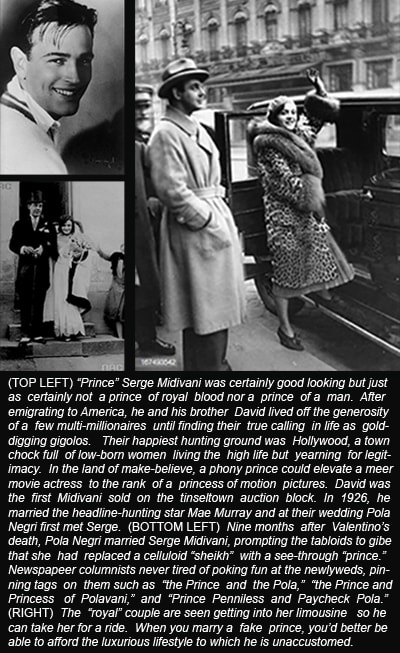
Serge Midivani, a fake "prince" marries Pola Negri after Valentino death

Negri drew more harsh criticism when, less than a year after Valentino's death, she suddenly married Serge Midivani. One of the so-called "marrying Midivanis," five siblings whose family had fled Russian Georgia during the Bolshevik revolution and relocated in the west. Though dirt poor, they cleverly gave themselves noble titles with which to attract rich, gullible women who dreamed of marrying Prince Charming. Serge Midivani overflowed with charm, was handsome and athletic, and gave himself the title of a prince. Negri may have been on the rebound from losing Valentino or smitten with Midivani's good looks or in love with the idea of becoming a "princess" but whatever her reasons for marrying Serge, public opinion said that her marriage to Serge Midivani was yet another publicity stunt which proved conclusively she had never loved Valentino.
 
supporting actors in silent film Hotel Imperial with Pola Negri 1927

Thus, in an attempt to regain public favor and revive box office revenue, Paramount replaced Negri's image as a beguiling vamp with that of a humble, down-to-earth maiden, pure of heart but still feisty and passionate. In Hotel Imperial she played Anna, a chambermaid at a small, rustic hotel in the Galician hinterlands. With unkempt hair, little makeup and dressed in ill-fitting rags, Anna swept floors, emptied dust bins, and secretly dreamed of romance. Anna was no better and no worse than the typical American girl who went to the movies twice a week.
 
clothes ripped off by Pola Negri in 1927 silent film

For the movie-going American male, who had been drawn to Negri's films by the sin, flesh and sexual situations they inevitably contained, Paramount gave Hotel Imperial suspense, danger and action in a plot involving warfare, spies and heroism--plus the added attraction of Negri performing what amounted to a strip-tease in the climactic scene.
 
Mauritz Stiller directs, Erich Pommer produces 1927 classic film

As would also be the case with Garbo and Dietrich during the sound era, Pola Negri's popularity in Europe remained strong throughout her silent film career and Paramount, in an effort to ensure or improve business for Hotel Imperial overseas, hired the great German producer Erich Pommer and the acclaimed Swedish director Mauritz Stiller to give the film a distinctly European atmosphere.
 
artistic film composition in silent film

So watch the dynamic, sensational, and ever controversial international legend of the silent screen, Pola Negri, in one of the most pivotal films of her illustrious career, as Sounds of Silents presents the GCM Production of a MaxManLA Video, Hotel Imperial, revitalized with synchronized symphonic music, digital image enhancement, original title cards reproduction, a new opening titles sequence and new World War I battle montage sequences.
 
Hollywood movie happy ending in classic movie Paramount Pictures

The link below offers FREE online viewing as well as several FREE downloading options.


LINK: HOTEL IMPERIAL (1927) with SYNCED MUSIC

presented by Sounds of Silents on blogger.com

Tuesday, June 16, 2020

Ashes of Vengeance (1923)

A classic showcase vehicle for silent-era superstar Norma Talmadge, revitalized with synchronized symphonic music, digital image enhancement, original title cards reproduction, a new opening titles sequence and a new historical setting prologue.
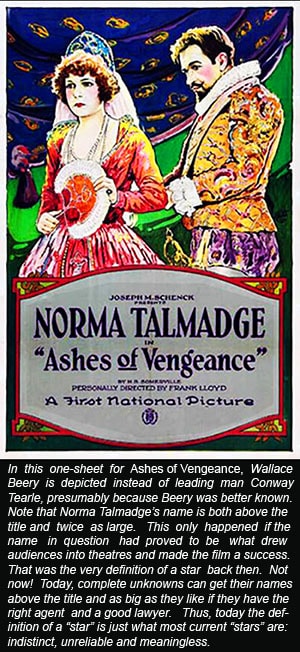
Advertisement poster "Ashes of Vengeance" 1923

A historical romance set in 16th Century France, Ashes of Vengeance is beautiful, grand, lavish, elegant and meticulously crafted to please its audience--all of which descriptions equally apply to its star, Norma Talmadge.
 

Norma Talmadge, Wallace Beery in "Ashes of Vengeance" color movie poster

She was one of the most famous people in the world during the 1920's. For most of the decade, she consistently ranked among the "top box-office draws"--a list created annually from a national poll of film exhibitors--and in 1923, the year Ashes of Vengeance was released, she was number one on the list. She received an average of 3,000 fan letters a week and earned a weekly salary of $10,000. Such merits put her stardom on par with Pickford, Fairbanks, Swanson and even Chaplin but, unlike those legendary deities of the silver screen, Norma Talmadge is all but completely forgotten today.
 

classic film, silent drama, directed by Frank Lloyd, a First National picture

How could such a huge star become so obscure? The blame rests with two simple but brutal culprits. First, she didn't survive the sound revolution--few silent stars did, but some had initial luck because public curiosity to hear them speak made their first few talkies financial, if not always critical, hits. Some silent film stars who faded soon after the arrival of sound had successful comebacks while others became even bigger stars in the sound era. Talmadge made just two talkies, both disastrous flops, after which she retired from acting and from public life. Enormously wealthy, she seemed not to have missed the adulation of her former legions of fans. One day in New York, a few years after her retirement, she was recognized by a woman who asked for an autograph, to which Talmadge replied, "Go away, dear--I don't need you any more."
 
movie music, promotional song, My Blue Heaven, I'll Get By, publicity

The second and most important reason Norma Talmadge is so forgotten that even college courses, books and websites devoted to cinema history and movie nostalgia rarely mention her is that most of her silent films are lost, in fragments or in such bad condition that viewing them is pointless--they show white, ghost-like figures playing scenes before light gray, blurry backgrounds while missing frames and sloppy rejoining of broken film cause everything to jump, jerk and shudder. Without enough decipherable evidence surviving from the past, history will not remember the dead.
 
Vintage magazine covers, sound revolution, fallen star, microphone 13

It seems almost providential that one of Talmadge's few intact, relatively well preserved silent triumphs should be called Ashes of Vengeance. Directed by Frank Lloyd, one of the premiere directors of the time, and produced by Talmadge's husband, Joseph M. Schenck, the film gives us a rare opportunity to see this magnificent star in all her glory.
 
Old movie makeup techniques, silent movie stars, film historyt

Aside from Talmadge, the cast includes leading man Conway Tearle, a stage actor who gives a seriously subdued performance as the stalwart hero who tries to remain true to his fickle fiancee even as he falls in love with the sister of his archenemy. In the role of the pompous but cowardly villain who, by arrangement of their noble families, expects to marry the unhappy but duty-bound heroine, Wallace Beery once again gives a scene stealing, bigger-than-life performance.
 
Dinner scene, movie heroine, silent film actor, character actor, French nobility

Without question, however, this is Norma Talmadge's film. Dressed in gorgeous period costumes, complimented by exquisite sets, art direction, lighting and cinematography, this production showcases Norma Talmadge in a manner befitting her status as a great film star.
 
Conway Tearle, French court, movie hero, Francisco, Talmadge

So treat yourself to the precious gift of experiencing the divine Norma Talmadge in one of her sensational vehicles, as Sounds of Silents presents the GCM Production of a MaxManLA Video, Ashes of Vengeance, revitalized with synchronized symphonic music, digital image enhancement, original title cards reproduction, a new opening titles sequence and a new historical setting prologue.

The link below offers FREE online viewing and several FREE downloading options. 


 ASHES OF VENGEANCE with synced symphonic music


Syncronized symphonic music, title cards reproduction, FREE download

Sunday, May 17, 2020

The Prisoner of Zenda  (1922)

Rex Ingram's stylish romantic adventure revitalized with synchronized symphonic music, digital image enhance-ment, original title cards reproduction, a new opening titles sequence and a new London-to-Ruritania travel montage.  Watch and/or download free!  (Link at end of post)


When Metro Pictures began production of The Prisoner of Zenda in 1921, Hollywood pundits scoffed and predicted disaster.  After all, the story of an Englishman who looks exactly like the soon-to-be  crowned king of a central European country and is coerced to play the part of the king after a villainous rival to the throne abducts the real king and imprisons him in the castle dungeon was at best an old-fashioned, fanciful yarn.  The widely read 1894 novel by Anthony Hope had been adapted for the stage and there had already been two film versions.  Hollywood doomsayers--always the first to pass judgment and the last to consider the facts--decreed that by making yet another film adaptation of Zenda, Metro was beating a dead horse.


But Metro had an ace in the hole--producer-director Rex Ingram.  The 30-year-old Irishman had first worked in movies as an actor, then a writer, and in 1916 began producing (or "supervising" as it was then called) and directing.  He worked for various companies such as Edison, Vitagraph and Fox in what was then the movie capital of the world, Fort Lee, New Jersey.


 In 1920, Ingram went to Hollywood and began working for Metro Pictures at their studio lot at Cahuenga Blvd. and Willoughby Ave.  Here, he collaborated with studio executive June Mathis on several films before their history-making production The Four Horsemen of the Apocalypse which was not only an enormous success both critically and financially, but also made Rudolph Valentino a star.


Ingram's films were marked with old-world style, elegance and beauty.  Director Erich von Stroheim called Ingram "the greatest film director in the world."  With The Prisoner of Zenda, Ingram had ample opportunity to showcase his thorough understanding of noble virtues--honor, duty, sacrifice, loyalty--as well as his appreciation of chivalric romance.  As Variety said in its review when the film was released, Zenda was "a natural" for the talents of its director.


He was also a connoisseur of talent--or, more importantly, of star quality.  When Valentino left Metro for Famous Players-Lasky (a.k.a. Paramount) Ingram discovered another Latin actor with enormous appeal to women, Mexican-born Ramon Novarro, who was cast in the star-making role of Rupert of Hentzau.  Another Ingram protegee was Alice Terry, who had worked as an extra in films until Ingram cast her in three of his films.  While making Zenda, Ingram and Terry left the studio one Friday, were married in Pasadena and returned to work the following Monday.  She continued playing leads in most of his films and the couple remained married until his death in 1950.

The decorative role of Antoinette, mistress of Black Michael, the dastardly rival for the Ruritanian throne, went to tall, dark and tempting Barbara La Marr, who was publicized as "the girl who is too beautiful" for one or both of two incidents.  The first happened when La Marr appeared in juvenile court on charges of petty delinquency and the judge said she was too beautiful to be alone in the big city and released her to her parents' care.  The second came when she worked as a writer at United Artists and Mary Pickford told her she was too beautiful to be behind the camera and shold become an actress.


La Marr's life was anything but beautiful.  When she was 16, she accused her older half-sister, Viola, and Viola's older, married boyfriend of kidnapping her and keeping her locked in a Santa Barbara hotel room for several days--for reason unspecified but easily imagined.  The couple released her but stood trial for kidnapping and La Marr testified against them but the case was dropped when police interrogators concluded La Marr's story lacked credibility.  Soon after this, she ran away to Arizona for several weeks and returned claiming she and a wealthy rancher had eloped to Mexico but soon after the wedding her husband died of pneumonia.  The same year, she married again and was soon divorced.  The pattern continued until, by 1922, she had gone through four husbands--or five, if the dubious first marriage is included.


In 1920, La Marr began acting in films, usually in secondary roles as a femme fatale.  Two major career boosts came in 1921 when she was cast first in Douglas Fairbanks' The Three Musketeers followed by The Prisoner of Zenda.  Accompanying the fame generated by these hit films, La Marr's notoriety as a premiere party girl of the Hollywood night life grew as well.  In a fan-magazine interview, she was quoted as saying she never slept more than two hours a day because she had better things to do than sleep.  Booze became her drug of choice and because binge drinking caused weight problems, she often went on crash diets.  Rumor had it that she once took a pill containing a tapeworm in order to help her loose weight fast.


Her reckless lifestyle led to increasing health problems, including pulmonary tuberculosis and kidney disease.  While working on a film in late 1925, she collapsed on the set and was rushed to the hospital, where she lapsed into a coma.  By the end of December, she had physically deteriorated to the point that she reportedly weighed just 88 pounds.  In January, 1926, the girl who is too beautiful became the girl who was too beautiful.  Barbara La Marr died at her parents' home in Altadena, California.  She was 29 years old.

Now see Barbara La Marr, Ramon Novarro, Alice Terry, Lewis Stone and Malcolm MacGregor in the GCM Production of a MaxManLA Video, Rex Ingram's The Prisoner of Zenda with synchronized symphonic music, digital image enhancement, original title cards reproduction, a new opening titles sequence and a new London-to-Ruritania travel montage.

The link below offers FREE online viewing as well as several FREE downloading options of the complete film.

THE PRISONER OF ZENDA (1922)