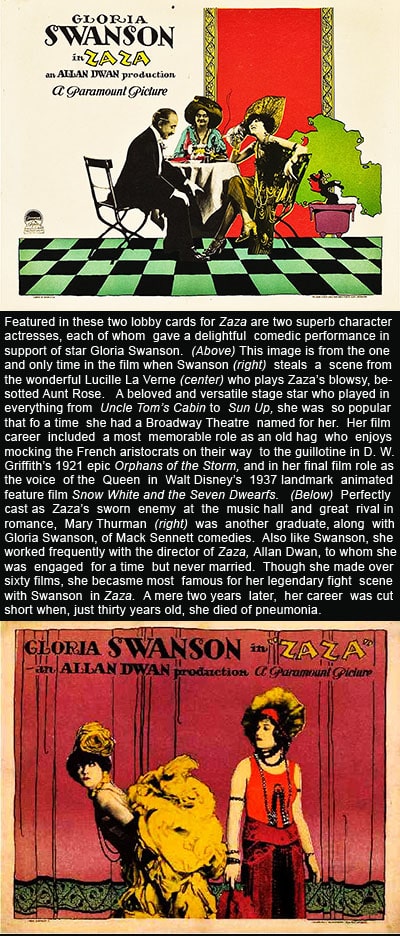
Gloria Swanson, superstar of the 1920's, is triumphant in the role that changed her career forever; directed by the great Alan Dwan, a silent-screen classic full of laughs, tears, fun and romance, revitalized with synchronized symphonic music, digital image enhancement, original title cards reproduction, and a new opening credfits sequence; a GCM Production of a MaxManLA Video presented by Sounds of Silents.
Gloria Swanson wanted to play the title character in Zaza for one reason--to prove she was a serious actress. Already a major film star, by 1923 she seemed to have everything--success, fame and fortune. The only thing she didn't have was respect for her talent. She was just as determined to gain recognition as a serious actress now as she had been to become a star when she first began working in films just eight years earlier.
She was fifteen when she entered the movies as an extra in short comedies. At sixteen, she caught the eye of Keystone Comedies mogul Mack Sennett, who teamed her with comedian Bobby Vernon in a series of sweet and popular romantic comedies. After a year, Sennett told her he intended to make her a second Mabel Normand--the top comedienne at Keystone who also happened to be Sennett's lover. Swanson said she didn't want to be a second anybody and Sennett promptly fired her.
What might have been the end of her film career was instead the lucky break she needed. Playing small parts in feature-length films, she came to the attention of Cecil B. De Mille, the top director at the company about to be called Paramount Pictures. She signed a seven year contract with the company and soon became De Mille's favorite actress, starring in one hit picture after another for him and in the process becoming a fast-rising star.
Paramount decided to remove her from De Mille's unit and when Swanson complained, the bosses told her she was now a star, capable of carrying her own vehicles. They said having two several stars in one picture with De Mille directing was like "putting all their eggs in one basket. Rather than have three stars in one De Mille picture, there was more money to be made by having one De Mille picture and three star-vehicle pictures.
This meant putting each star under contract to Paramount in a string of feature films all created from the same formula. In Swanson's case, the recipe called for glamour, romance, high society and especially clothes, lots and lots of exotic, extravagant, outlandish and even absurd gowns, hats, shoes, jewelry and furs. These pictures made Swanson one a top-ten star but she knew and resented the fact that she was famous for nothing more than being a beautiful clothes horse. No one considered her a true actress.
When she asked the studio executives to give her roles with substance, films with good plots, they warned her against tampering with a successful formula. She realized if they continued giving her nothing but silly, empty star vehicles, sooner or later the public would tire of them and of her. Something had to change or her career would be finished when her current Paramount contract expired.
To escape Paramount's short-term plans for her, Swanson told her bosses that she needed serious medical attention at a New York hospital, then took the train to New York. Whether or not she had a health issue requiring special treatment didn't matter, at least not to Swanson. She left Hollywood because at Paramount's east coast studios director Alan Dwan was preparing a new picture and Swanson wanted the lead role. She wanted to play Zaza.
Since its premiere on the Paris stage in 1898, Zaza had become the play every great dramatic actress used to show her range and versatility. The character of Zaza, a lowly prostitute who becomes a provincial music hall star and the mistress of a married Parisian dignitary was full of contradictions. She was crass, vulgar and tempestuous but also sensitive, intelligent and vulnerable.
Swanson recognized much of herself in Zaza and believed she could give a strong performance. She also knew the Paramount bosses would scoff at the suggestion of casting her as Zaza--and everyone in Hollywood would laugh at the very idea of the famous clothes horse playing such a famously difficult part.. To get the part, she needed a champion on her side, someone the studio executives respected.
That someone was director Alan Dwan,. He had just finished directing Robin Hood with Douglas Fairbanks and that picture's enormous success gave him the clout Swanson needed in her corner.. Initially, Dwan was skeptical of Swanson's ability to play the part but after several meetings and much discussion, Dwan gave in and lobbied on her behalf. As expected, the studio bosses trusted Dwan's opinion and nervously consented to the casting of Gloria Swanson as Zaza.
To Paramount's surprise and delight, Zaza was a box office hit, taking in almost half a million dollars. To the shock and disbelief of everyone except the film's star and its director, Swanson was superb in the role. Her triumph in Zaza put her career on a new path. She now had her pick of any part, no matter how dramatic or difficult. She now had the recognition of her talent and the respect as an artist that she deserved. After Zaza, no one ever took Gloria Swanson for granted again.
Now, you can watch and enjoy the great Gloria Swanson in Alan Dwan's adaptation of the celebrated French play as Sounds of Silents presents the GCM Production of a MaxManLA video, Zaza, a silent film classic revitalized with synchronized symphonic music, digital image enhancement, original title cards reproduction and a new opening titles sequence.
The link below offers FREE online streaming as well as several FREE download options.
Legendary star Pola Negri in a World War I drama of espionage, heroism and romance--a silent super- production revitalized with synchronized symphonic music, digital image enhancement, original title cards reproduction, a new opening titles sequence, a new Gallician history montage sequence and new World War One battle sequences.
The purpose behind making Hotel Imperial was to boost the sagging popularity of Pola Negri. Polish born and formerly the greatest female star in German cinema, she had dazzled American film audiences with her image as the glamorous, passionate, worldly femme fatale in a stringof romantic melodramas for Paramount Pictures since 1922. Now, five years into the game of fantastic--and usually fake--publicity stories and rehashed formula film vehicles, the public was growing weary of Pola and bored by her films.
Making matters worse for her film career was her personal life--which was certainly not private. Negri's high-profile love affair with the original Latin lover of the movies, Rudolph Valentino, had initially thrilled their fans and had become serious enough that stories claiming they were engaged to be married began appearing in newspapers around the world. When Valentino died suddenly of peritonitis in 1926, millions of people felt a deep, personal loss and mourned him reverently.
So Negri's actions at Valentino's New York funeral created a scandal that turned the public's sympathy for her into condemnation of her. Negri fainted repeatedly before the thousands of people gathered outside the funeral parlor and, even worse, her every sob, wail and collapse was reported and photographed by the press. The next day, headlines in newspapers worldwide jeered, hissed and vilified Negri for what the press implied, but never stated, was a publicity stunt.
If it was for publicity, it certainly succeeded. Negri's name and face were unavoidable, plastered on newspaper front pages and magazine covers everywhere. But was it all for publicity? Negri was no fool and must have known in advance what public reaction would be to her using Valentino's funeral for self promotion. For the rest of her life, Negri said Valentino was the love of her life and that, being Polish, her extreme and uncontrollable emotions were typical of Slavic people, who considered suppressing one's agonizing grief at a funeral to be shameful, contemptible behavior. She might just have been telling the truth about this--think of all the scenes on television news broadcasts in the 1990's during the wars in the Balkans, showing men and women screaming, tearing at their hair and, yes, fainting over the deaths of loved ones.
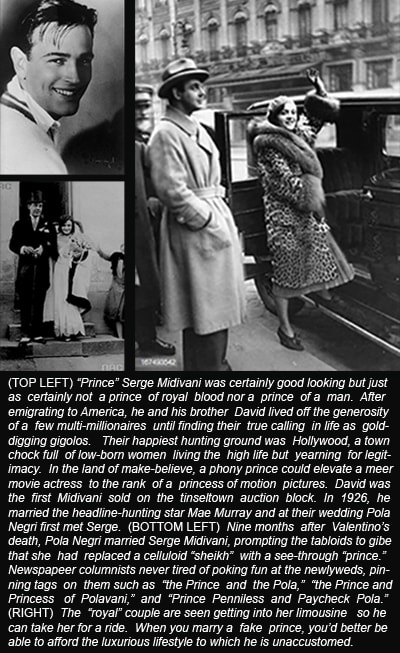
Negri drew more harsh criticism when, less than a year after Valentino's death, she suddenly married Serge Midivani. One of the so-called "marrying Midivanis," five siblings whose family had fled Russian Georgia during the Bolshevik revolution and relocated in the west. Though dirt poor, they cleverly gave themselves noble titles with which to attract rich, gullible women who dreamed of marrying Prince Charming. Serge Midivani overflowed with charm, was handsome and athletic, and gave himself the title of a prince. Negri may have been on the rebound from losing Valentino or smitten with Midivani's good looks or in love with the idea of becoming a "princess" but whatever her reasons for marrying Serge, public opinion said that her marriage to Serge Midivani was yet another publicity stunt which proved conclusively she had never loved Valentino.
Thus, in an attempt to regain public favor and revive box office revenue, Paramount replaced Negri's image as a beguiling vamp with that of a humble, down-to-earth maiden, pure of heart but still feisty and passionate. In Hotel Imperial she played Anna, a chambermaid at a small, rustic hotel in the Galician hinterlands. With unkempt hair, little makeup and dressed in ill-fitting rags, Anna swept floors, emptied dust bins, and secretly dreamed of romance. Anna was no better and no worse than the typical American girl who went to the movies twice a week.
For the movie-going American male, who had been drawn to Negri's films by the sin, flesh and sexual situations they inevitably contained, Paramount gave Hotel Imperial suspense, danger and action in a plot involving warfare, spies and heroism--plus the added attraction of Negri performing what amounted to a strip-tease in the climactic scene.
As would also be the case with Garbo and Dietrich during the sound era, Pola Negri's popularity in Europe remained strong throughout her silent film career and Paramount, in an effort to ensure or improve business for Hotel Imperial overseas, hired the great German producer Erich Pommer and the acclaimed Swedish director Mauritz Stiller to give the film a distinctly European atmosphere.
So watch the dynamic, sensational, and ever controversial international legend of the silent screen, Pola Negri, in one of the most pivotal films of her illustrious career, as Sounds of Silents presents the GCM Production of a MaxManLA Video, Hotel Imperial, revitalized with synchronized symphonic music, digital image enhancement, original title cards reproduction, a new opening titles sequence and new World War I battle montage sequences.
The link below offers FREE online viewing as well as several FREE downloading options.