Rex Ingram's stylish romantic adventure revitalized with synchronized symphonic music, digital image enhance-ment, original title cards reproduction, a new opening titles sequence and a new London-to-Ruritania travel montage. Watch and/or download free! (Link at end of post)
When Metro Pictures began production of The Prisoner of Zenda in 1921, Hollywood pundits scoffed and predicted disaster. After all, the story of an Englishman who looks exactly like the soon-to-be crowned king of a central European country and is coerced to play the part of the king after a villainous rival to the throne abducts the real king and imprisons him in the castle dungeon was at best an old-fashioned, fanciful yarn. The widely read 1894 novel by Anthony Hope had been adapted for the stage and there had already been two film versions. Hollywood doomsayers--always the first to pass judgment and the last to consider the facts--decreed that by making yet another film adaptation of Zenda, Metro was beating a dead horse.
But Metro had an ace in the hole--producer-director Rex Ingram. The 30-year-old Irishman had first worked in movies as an actor, then a writer, and in 1916 began producing (or "supervising" as it was then called) and directing. He worked for various companies such as Edison, Vitagraph and Fox in what was then the movie capital of the world, Fort Lee, New Jersey.
In 1920, Ingram went to Hollywood and began working for Metro Pictures at their studio lot at Cahuenga Blvd. and Willoughby Ave. Here, he collaborated with studio executive June Mathis on several films before their history-making production The Four Horsemen of the Apocalypse which was not only an enormous success both critically and financially, but also made Rudolph Valentino a star.
Ingram's films were marked with old-world style, elegance and beauty. Director Erich von Stroheim called Ingram "the greatest film director in the world." With The Prisoner of Zenda, Ingram had ample opportunity to showcase his thorough understanding of noble virtues--honor, duty, sacrifice, loyalty--as well as his appreciation of chivalric romance. As Variety said in its review when the film was released, Zenda was "a natural" for the talents of its director.
He was also a connoisseur of talent--or, more importantly, of star quality. When Valentino left Metro for Famous Players-Lasky (a.k.a. Paramount) Ingram discovered another Latin actor with enormous appeal to women, Mexican-born Ramon Novarro, who was cast in the star-making role of Rupert of Hentzau. Another Ingram protegee was Alice Terry, who had worked as an extra in films until Ingram cast her in three of his films. While making Zenda, Ingram and Terry left the studio one Friday, were married in Pasadena and returned to work the following Monday. She continued playing leads in most of his films and the couple remained married until his death in 1950.
The decorative role of Antoinette, mistress of Black Michael, the dastardly rival for the Ruritanian throne, went to tall, dark and tempting Barbara La Marr, who was publicized as "the girl who is too beautiful" for one or both of two incidents. The first happened when La Marr appeared in juvenile court on charges of petty delinquency and the judge said she was too beautiful to be alone in the big city and released her to her parents' care. The second came when she worked as a writer at United Artists and Mary Pickford told her she was too beautiful to be behind the camera and shold become an actress.
La Marr's life was anything but beautiful. When she was 16, she accused her older half-sister, Viola, and Viola's older, married boyfriend of kidnapping her and keeping her locked in a Santa Barbara hotel room for several days--for reason unspecified but easily imagined. The couple released her but stood trial for kidnapping and La Marr testified against them but the case was dropped when police interrogators concluded La Marr's story lacked credibility. Soon after this, she ran away to Arizona for several weeks and returned claiming she and a wealthy rancher had eloped to Mexico but soon after the wedding her husband died of pneumonia. The same year, she married again and was soon divorced. The pattern continued until, by 1922, she had gone through four husbands--or five, if the dubious first marriage is included.
In 1920, La Marr began acting in films, usually in secondary roles as a femme fatale. Two major career boosts came in 1921 when she was cast first in Douglas Fairbanks' The ThreeMusketeers followed by The Prisoner of Zenda. Accompanying the fame generated by these hit films, La Marr's notoriety as a premiere party girl of the Hollywood night life grew as well. In a fan-magazine interview, she was quoted as saying she never slept more than two hours a day because she had better things to do than sleep. Booze became her drug of choice and because binge drinking caused weight problems, she often went on crash diets. Rumor had it that she once took a pill containing a tapeworm in order to help her loose weight fast.
Her reckless lifestyle led to increasing health problems, including pulmonary tuberculosis and kidney disease. While working on a film in late 1925, she collapsed on the set and was rushed to the hospital, where she lapsed into a coma. By the end of December, she had physically deteriorated to the point that she reportedly weighed just 88 pounds. In January, 1926, the girl who is too beautiful became the girl who was too beautiful. Barbara La Marr died at her parents' home in Altadena, California. She was 29 years old. Now see Barbara La Marr, Ramon Novarro, Alice Terry, Lewis Stone and Malcolm MacGregor in the GCM Production of a MaxManLA Video, Rex Ingram's The Prisoner ofZenda with synchronized symphonic music, digital image enhancement, original title cards reproduction, a new opening titles sequence and a new London-to-Ruritania travel montage. The link below offers FREE online viewing as well as several FREE downloading options of the complete film.
Cecil B. DeMille's epic silent masterpiece revitalized with synchronized symphonic music, digital image enhancement, original title cards reproduction and a new opening titles sequence.
A landmark silent epic, Cecil B. DeMille's 1923 production The Ten Command-ments astounded audiences and critics alike with its unprecedented grandeur, opulence and--as with many DeMille films--righteous self-importance.
"Cecil B. DeMille's name is written in letters of fire and gold across the pages of cinema history!" said publicity ads in movie-fan magazines of the 1920's. In the years between World War I and the Roaring 20's, DeMille found popular success with a series of sophisticated marital comedies such as Don't Change Your Husband and Why Change Your Wife?--films that made Gloria Swanson a star and established DeMille's career-long reputation for embellishing scenes with risqué sexual overtones.
By the early 1920's, an increasing number of churches and community groups were becoming alarmed and outraged by the reckless immorality so casually depicted in the films of many successful directors. Along with threats of censorship and boycotts, these groups kept demanding movies with clean, godly, uplifting stories. DeMille, ever pandering to the broadest possible audience, decided that if the public wanted sermons, he'd give them sermons--fully illustrated.
The Ten Commandments added a new, key ingredient to the DeMille film formula: religion. As his niece, Agnes de Mille, said, the pairing of lurid sexuality with extreme religious fervor proved "unbeatable as a combo." The formula never failed him. For the rest of his career, his biggest hits contained this magic mixture of sex and God: The King of Kings (1927), The Sign of the Cross (1932), Samson and Delilah (1949) and the remake of The Ten Commandments (1956).
Unlike the remake, the 1923 film has two parts: the Prologue, depicting the Biblical tale of the Israelites' exodus from Egypt, and the Story, a 1920's melodrama about two brothers, one good and one bad. Much derided by viewers today, the film's modern story catered to audience preferences of the time--costume pictures were generally not popular with a movie-going public increasingly enthralled by the "roaring" jazz age. Thus, after Moses, Pharaoh and the wrath of God, audiences were treated to flappers, vamps and the vices of capitalism.
So prepare to be dazzled and delighted, as Sounds of Silents presents a GCM Production of a MaxManLA Video: THE TEN COMMANDMENTS (1923), with synchronized symphonic music, digital image enhancement, original title cards reproduction and a new opening titles sequence. The link below offers FREE online viewing and several FREE downloading options.
A silent classic revitalized with synchronized music, image enhancement, original title cards reproduction and a new opening-titles sequence
Big, lavish, expensive productions were
abundant in the 1920's--The Ten Commandments, Ben-Hur, Orphans of the Storm,
Scaramouche, The Queen of Sheba, The Sea Hawk, The King of Kings, to name
but a few--but for sheer entertainment, few could match Douglas
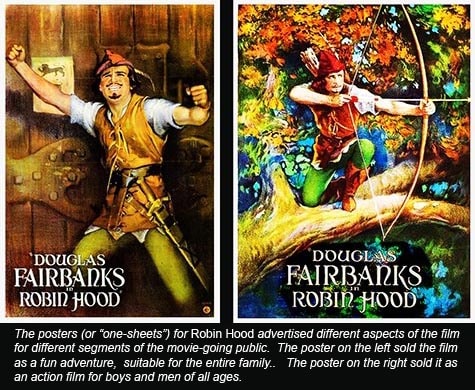
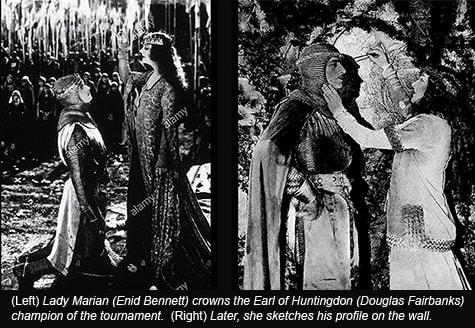
Fairbanks' 1922 production of Robin Hood.
Though not the first film based on the
medieval folk tales of a fallen Saxon noble who robs the rich and rewards the
poor (a short British feature, Robin Hood and His Merry Men, was
made in 1908), this production, with
its colossal sets and a cast, literally, of thousands, was one of the first
films to cost over one million dollars.
Fairbanks himself wrote the story (as
"Elton Thomas," his favorite pseudonym) and hired Alan Dwan to
direct. One of the so-called "Big
Four" directors of the 1920's (the others were D. W. Griffith, Cecil B. De
Mille and Rex Ingram), Dwan was a master at mixing comedy with drama, thus he
worked well--and often--with Fairbanks, whose films always had a playful,
devil-may-care tone.
Some interesting incidentals:
* Robin Hood was the first film to have its world premiere in Hollywood. The great event was held on October 18, 1922, at Grauman's Egyptian Theatre at 6706 Hollywood Blvd. (now the home of the American Cinematheque).
* Alan Hale (father of Alan Hale Jr., who played the Skipper in the TV series Gilligan's Island) played Little John in both this 1922 production and ithe 1938 Technicolor production The Adventures of Robin Hood starring Errol Flynn.
* Some of the sets for Robin Hood were designed by famed architect Frank Lloyd Wright.
* The famous castle set was bigger even than the massive Babylonian set in D. W. Griffith's 1917 epic, Intolerance.
* A year after appearing in Robin Hood, Wallace Beery (who had the dubious honor of being Gloria Swanson's first husband) portrayed King Richard again in the 1923 film Richard the Lionhearted.
* In 1938, when Douglas Fairbanks learned that a "remake" of Robin Hood was in pre- production, he threatened to sue Warner Bros. for copyright infringement of his 1922 screen story and wasn't appeased until his lawyers read the shooting script for The Adventures of Robin Hood and determined there were no grounds for a lawsuit.
Now, almost 100 years after its premiere, Sounds of Silents proudly presents
the GCM Production of a MaxManLA Video, ROBIN HOOD, with synchronized
symphonic music, digital image enhancement, original title cards reproduction
and a new opening titles sequence. The link below offers FREE online viewing and several FREE downloading options.